

The Wonderful Story
of Henry Sugar
Working on Wes Anderson’s The Wonderful Story of Henry Sugar was a truly special experience for Fantasy Greens. The film’s distinctive visual style demanded precision, restraint, and a playful approach to natural detail. Our role was to introduce carefully crafted greenery that would support the theatrical, storybook quality of the sets while still grounding them in a tangible world.


The Jungle
The jungle set needed to feel expansive, vibrant, and slightly surreal; a place where nature itself became part of the storybook.
The art of Henri Rousseau was a key influence on the design, and we embraced his style as a guide in shaping the look and feel of the greenery. Layers of foliage, vibrant artificial plants and stylised canopy structures were arranged almost like brushstrokes, balancing density with colour to create a landscape that felt dreamlike yet ordered.
Every element was positioned to echo Anderson’s painterly aesthetic while nodding to Rousso’s artistic language.


Roald Dahl's House
The set of Roald Dahl’s house required us to manipulate scale and perspective to create a set much aligned to Wes Anderson's art style. To achieve this, we used multiple sizes of shrubs and tree branches, carefully positioning them to create depth and trick the eye.
Alongside these, we built a series of miniature trees, scaled and shaped to recede naturally into the background, giving the illusion of distance. The result was a forced perspective effect that felt whimsical, in keeping with Wes Anderson’s theatrical, storybook aesthetic.


Town Square
To create the town square in 'The Rat Catcher' we added ground cover and perimeter details that gave the square its texture and character. We also introduced patches of turf and worn earth to suggest long use and soften the edges of stonework.
Alongside ground treatments and subtle shrub placements to give the square texture and authenticity, one of our key contributions was crafting a line of forced perspective hedging. By carefully scaling the hedge elements, we were able to trick the eye into believing the road into the square extended further than it truly did, adding depth without breaking the contained, stage-like quality of the environment.


Hay Field
The challenge of the Hay Field was to evoke the scale of a wide, open landscape within the controlled limits of a stage.
To achieve this, we built tufts of wheat in various sizes, carefully arranged to draw the eye into the distance and reinforce the illusion of depth.
The field itself was also constructed with a gentle slope, a deliberate choice to exaggerate perspective and make the horizon feel further away than it truly was.
The combination of graded planting and angled ground produced a convincing sense of expanse while retaining the stylised, storybook quality of Wes Anderson’s world.


Hedgerows
The hedgerows in 'The Swan' were a key element in shaping the rural English landscape at the heart of the story.
Rather than building fully three-dimensional structures, the brief called for a highly controlled, stylised approach. To achieve this, we fixed layers of natural material including straw, heather, and other textural elements onto wooden boards, creating clean, flat edges that could read convincingly as hedgerows on camera.
This method allowed us to capture the linear precision that Wes Anderson’s aesthetic demands, while still grounding the look in recognisable rural detail. The result was a set that felt both theatrical and authentic, a landscape built as much from illusion as from material.


.png)


.png)
.png)
.png)

Lake and Nest
The lake set in The Swan was a beautiful example of illusion through design. Built entirely on stage, it relied on crafted detail to suggest a natural body of water without ever attempting full realism.
To bring this vision to life, we constructed artificial bullrushes along the water’s edge, each carefully scaled and positioned to give the illusion of depth and continuity while remaining consistent with Wes Anderson’s pared-back aesthetic. One of the set’s centrepieces was a willow tree we built specifically for the production — its long, draping branches designed as much for graphic composition as for atmosphere. Together, the willow and bullrushes created a frame for the lake that felt painterly and deliberate, evoking a countryside scene through artifice rather than realism. For Fantasy Greens, this set was about embracing illusion — using constructed natural forms to build a landscape that was both recognisable and heightened, in perfect keeping with the storybook quality of the film.


Poison Cottage
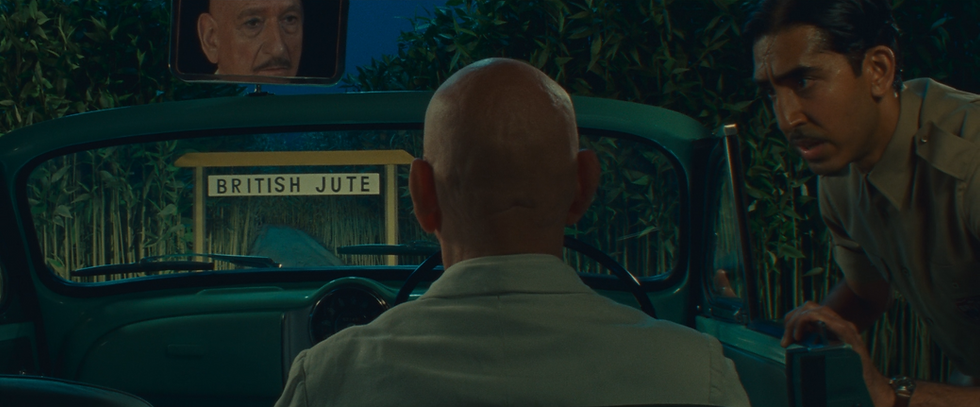
The cottage in Poison was designed as a highly controlled, storybook environment, and all the greenery was artificial, giving us complete control over composition and scale.
We installed bamboo and a variety of shaped shrubs, carefully positioning them to frame the building and enhance the whimsical, theatrical quality of the set. Each element was crafted to read beautifully within Wes Anderson’s compositions, adding texture and depth without ever overwhelming the architecture.
.png)
.png)


